When South Korea’s AI Basic Act took effect on 22 January 2026, it did so as only the second comprehensive national AI law in the world — following the EU AI Act — and the most prescriptive AI governance framework in the Asia-Pacific region. That was no accident. The legislation reflects a deliberate national calculation: that establishing clear legal boundaries around AI development and deployment is not a constraint on growth, but a precondition for it. The government’s stated aims are to protect citizens’ rights and dignity, improve quality of life, and — critically — strengthen national competitiveness. Behind that framing sits a harder ambition: President Lee Jae-myung, who took office in June 2025, has publicly set a goal of positioning Korea among the world’s top three AI nations, with the Act serving as both a governance foundation and a signal to international investors and partners that Korea is building for the long term.
It has now been more than three months since the Act took effect. What has become clearer over that period is not the law itself, but the government’s approach to implementing it — and the much larger industrial strategy that is unfolding alongside it.
Buying time on compliance: phased implementation and the grace period
In the first phase after enforcement, the signal from government has been relatively consistent: the law is in force, but implementation is being phased carefully. The Library of Congress noted in February that the Korean government was emphasising guidance and support in the early period, including a grace period of at least one year before administrative fines are imposed. That matters because it reframes the immediate challenge for companies. The pressing issue is not punitive enforcement — fines under the Act are capped at 30 million KRW for most violations — but how to build internal processes for transparency obligations, high-impact AI assessment, and user-facing accountability before that grace period ends. For multinational firms operating in Korea, the practical priority is building the right governance infrastructure now, not waiting for regulators to force the issue.
From domestic rule-setting to international positioning
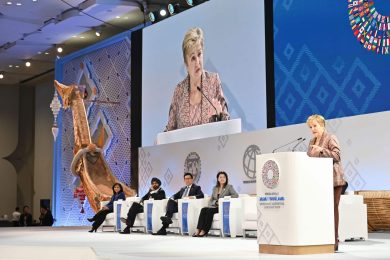
Alongside the compliance story, a second and arguably more significant development emerged in mid-February — one that signals a shift in how Korea is framing the Act beyond its own borders. On 19 February, Science Minister Bae Kyung-hoon travelled to an international AI conference in India, where he shared Korea’s AI transformation policies and its experience implementing the AI Basic Act. Minister Bae’s appearance in New Delhi offers the clearest illustration of how Korea’s messaging around the Act has evolved: the government is no longer presenting it primarily as a domestic regulatory instrument, but as a component of Korea’s international AI brand. The Act is being positioned as evidence that Korea can govern AI responsibly and competitively at the same time — a message directed as much at foreign investors and partner governments as at domestic businesses. That tonal shift matters. It suggests Korea intends to use its governance framework as a soft-power and investment-attraction asset, not merely a compliance regime.
A widening regulatory perimeter: copyright, data, and training inputs
A third development since mid-February is that the regulatory landscape around AI has begun to widen beyond the Basic Act itself. On 26 February, the government released new guidance on how copyrighted works may be used in training generative AI models. The guidance indicates that open-access academic papers may, in some cases, qualify as fair use for training purposes, while the use of news articles for summary services without permission is unlikely to do so. For businesses, this matters because the real post-enforcement environment is taking shape across multiple policy fronts simultaneously — not just transparency and high-impact AI obligations under the Basic Act, but also data access, licensing, and the lawfulness of training inputs under copyright policy. The Korean AI regulatory environment, in other words, is becoming more layered over time, not less. Companies that scope their compliance work narrowly around the Basic Act risk missing obligations that are accumulating in adjacent domains.
The industrial build-out: infrastructure, compute, and capital
What has changed most visibly by late February and March is the scale of industrial and infrastructure commitment that is now moving in parallel with the regulatory framework. On 11 February, Reuters reported that OpenAI, Samsung SDS, and SK Telecom were preparing to begin construction of data centres in Korea in March. On 27 February, Reuters reported that Hyundai Motor Group and the Korean government had signed a deal involving an AI data centre project equipped with 50,000 GPUs. On 1 March, Reuters reported that South Korea’s semiconductor exports had jumped 160.8% year-on-year in February, reaching record levels for a third consecutive month — with the trade ministry explicitly attributing the surge to AI investment and rising memory prices.
These are not peripheral developments. They show that Korea’s AI market is being shaped not primarily by compliance obligations, but by a rapid and government-backed build-out of compute capacity, power infrastructure, and industrial partnership. The regulatory framework and the industrial strategy are being constructed in tandem.
Doubling down on domestic capability: the semiconductor dimension
By March, the industrial story had sharpened further around a specific priority: domestic semiconductor capability. On 19 March, Reuters reported that Samsung Electronics planned to invest more than 110 trillion won this year in research, development, and facilities to lead the semiconductor industry in AI. A week later, on 26 March, Reuters reported that a state-backed fund had approved a 250 billion won investment in Rebellions, an AI chip startup, as part of a broader push to develop a homegrown advanced semiconductor champion. Together, these moves make the government’s underlying logic more visible: Korea is not simply trying to attract foreign AI investment; it is trying to ensure that the industrial capacity underpinning AI — compute, chips, and infrastructure — has a meaningful domestic component. The AI Basic Act does not directly drive these decisions, but it sits within the same strategic frame.
Bottom line
Three months in, the most accurate reading of Korea’s AI Basic Act is neither “startup chaos” nor simple “regulatory stabilisation.” It is something more structural. The government appears to be deliberately buying time on enforcement through phased implementation and the grace period, while moving considerably faster on the industrial side to secure AI infrastructure, data centre capacity, and domestic chip capability. For foreign businesses, that combination creates a specific operating challenge: Korea still offers substantial market and investment opportunities, but navigating them successfully requires reading the environment through both lenses at once — compliance with a layered and still-evolving regulatory framework, and alignment with a policy environment that is increasingly focused on strategic AI capacity and national technological self-reliance. The law matters. But the larger story at the three-month mark is that Korea is trying to govern AI and scale it at the same time — and the pace of the latter may prove more consequential than the fine print of the law itself.
Sources