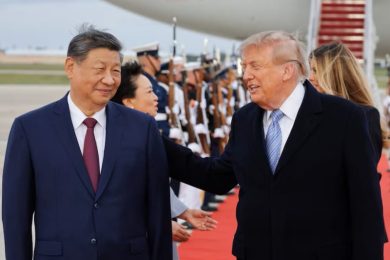
In a whirlwind week of diplomacy, President Trump held two high-stakes summits in Asia—one with Chinese President Xi Jinping in Busan, South Korea and the second with Japanese Prime Minister Sanae Takaichi in Tokyo. These meetings, set against the backdrop of APEC week and rising geopolitical tensions, offered a glimpse into the evolving dynamics of US engagement in the Indo-Pacific region. While both summits yielded headline-grabbing agreements, they also exposed the fragility and complexity of America’s strategic position in the region.
Trump-Takaichi Summit: Expanding the Alliance
President Trump met with Premier Takaichi in Tokyo from October 27–29. This summit focused on economic cooperation and defence alignment, with Japan navigating a leadership transition and major defence reforms.
Highlights included:
- Japanese companies observing US$400 billion in US investments across energy, AI and critical minerals
- A pledge of US$550 billion in strategic investments and guarantees to facilitate US tariffs
- A landmark Technology Prosperity Deal on semiconductors and high-performance computing
- A Hitachi–US Commerce Department agreement to modernize the power grid
Japan expressed interest in purchasing US defence equipment, including Ford’s F-150 pickup truck. Takaichi praised US diplomacy in Southeast Asia and the Middle East. Both leaders visited a US naval base near Tokyo which highlighting the alliance’s military attribute.
Trump-Xi Summit: Tactical Truce, Not Strategic Reset
On October 30, President Trump and President Xi met at the Nurimaru APEC House for a last-minute summit as trade tensions between the U.S. and China escalated. With tariff threats climbing to 145% and China tightening its grip on rare earth exports, shaking up global supply chains, the meeting was a quick attempt to cool things down.
Key outcomes included:
- Tariff reductions on Chinese goods from 57% to 47%
- One-year suspension of China’s rare earth export restrictions
- Fentanyl-related tariff cuts from 20% to 10%
- Continuation of Chinese purchases of US soybeans
Despite these considerations, the summit was best described as a strategic truce. No solid agreements came out of the talks, and important issues like the tech split and ongoing competition between the two countries were left hanging. With no clear statement from China and only vague plans for follow-through, many were left wondering how long any progress would actually last.
Technology remained a sticking point. While the US agreed to arbitrate future Nvidia-China negotiations, Blackwell AI chips were clearly excluded, and existing export controls stayed intact. This signalled that the structural competition in semiconductors and AI would continue.
Market reactions were mixed. The Shanghai Composite Index dipped slightly on summit day, and analysts warned that Trump’s unpredictable tone could reignite tensions. As Dickie Wong of Kingston Securities noted, “There could be disappointing developments.”
Regional Ripples and ASEAN Dynamics
Both summits unfolded amid shifting regional currents. On October 28, China and ASEAN signed the upgraded ACFTA 3.0, expanding cooperation in digital economy and green growth. This move signalled accelerating regional integration and a push for ASEAN strategic autonomy.
Japan and the US, meanwhile, are doubling down on efforts to counter China’s manufacturing dominance in EVs, AI, and semiconductors. Japan’s role as a “strategic hedge” is becoming more pronounced, especially as middle powers like South Korea, Australia and Singapore recalibrate their positions.
The rare earth deal from the Trump-Xi summit brings some short-term relief, but it also shows just how important it is for the U.S. to diversify its supply chains. To cut back on relying so heavily on China’s processing power, the U.S. is actively building ties with countries like Australia and those across Southeast Asia.
Looking Ahead: Fragile Gains, Strategic Uncertainty
While both summits delivered short-term wins, long-term uncertainties till remain. The Trump administration’s transactional style and Japan’s political instability could hinder sustained progress. Takaichi’s limited mandate may make it difficult to resist US pressure on economic rebalancing and defence burden-sharing.
In the case of China, the lack of binding commitments and enforcement mechanisms means the November 10 tariff truce extension remains a critical inflection point. The spectre of “weaponized interdependence” continues to challenge the traditional open regional order.
Ultimately, these two summits reflect a strategic recalibration rather than a resolution. As Asia’s geopolitical chessboard evolves, the US, China, and Japan are manoeuvring for influence, each with their own restrictions, motivations and weaknesses.
Sources
- https://edition.cnn.com/politics/live-news/trump-south-korea-china-xi-government-shutdown-10-29-25
- com/news/articles/2025-10-30/trump-says-amazing-meeting-with-xi-yielded-fentanyl-tariff-cut
- https://www.cnbc.com/2025/10/30/trump-and-xi-land-busan-meeting-trade-and-tariffs-.html
- https://www.chosun.com/english/national-en/2025/10/30/GNQ2OLWMMJAMHCPGCLXEJ5MIL4/
- https://www.reuters.com/world/china/trump-says-nvidias-high-end-blackwell-chip-did-not-figure-talks-with-chinas-xi-2025-10-30/
- https://www.reuters.com/world/us/live-trump-xi-meet-south-korea-trade-2025-10-30/
- https://www.nytimes.com/2025/10/29/us/politics/trump-china-nvidia-chips-sales.html
- https://abcnews.go.com/Politics/trump-xi-meeting-fate-global-economy-hangs-balance/story?id=126978226