Amidst the geopolitical turmoil in the Middle East, the European Union (EU) has quietly laboured to conclude free trade and security agreements in the Indo-Pacific region. This is seen in its recent conclusion of negotiations for the Australia-EU free trade agreement (FTA) in March 2026, following talks that began in July 2018. The deal is EU’s latest FTA in the strategic Indo-Pacific region, and is part of its broader plans to expand its web of bilateral partnerships. Likewise, the EU has finalised FTA negotiations with Indonesia in September 2025, and with India in January 2026. This push can be best read as a strategic hedge against a more unsettled global order.
A trade strategy shaped by geopolitics
FTAs – as traditionally conceived – are no longer simply about tariff reduction efforts. Countries are using FTAs to widen its political relationships, strengthen supply-chain resilience and give regional partners another option between China’s economic pull and America’s more volatile policy cycle. In the case of the EU, it can credibly offer market access, regulatory predictability and long-term institutional engagement – highly attractive features to preserve regulatory stability in the Indo-Pacific region.
For Europe, the gains of inking FTAs are commercial as well as strategic, with diversification as its most immediate driver. Europe remains heavily exposed to China as a production base, export market and source of critical inputs. Recent years have shown how quickly economic interdependence can turn into leverage. FTAs with Indo-Pacific partners help European firms avoid excessive concentration in any single supply chain. Incidentally, Australia and the EU also unveiled a Security and Defence Partnership the same day it announced its trade deal, underlining that this is as much about strategic alignment as it is about tariffs. For Indo-Pacific partners, the appeal is equally practical – they may view cooperation with the EU as a strategic diversification from its existing trade and securities architecture. For example, India has become more willing to pursue targeted FTAs with partners that suit its industrial priorities. ASEAN economies gain another route to attract investment, move up value chains and signal openness without being forced into a binary US-China frame.
Secondly, the EU is often seen in Asia as a regulatory actor rather than a security power. Trade agreements allow the EU to project influence in a way that fits its institutional strengths and appeals to partners seeking economic depth without military alignment. The EU-India FTA, concluded in January 2026 after years of difficult negotiations, is a useful example. It links Europe to one of Asia’s largest growth markets while complementing India’s own geoeconomic strategy: selective trade openness, strategic autonomy and reduced dependence on China. The EU-Indonesia Comprehensive Economic Partnership (CEPA), finalised in September 2025, follows a similar logic in ASEAN, where Indonesia’s scale and resources make it a natural partner.
Rules-setting is the third pillar. The EU maintains high standards on sustainability, labour, procurement, digital governance, competition and regulatory cooperation. Indo-Pacific trade rules are being shaped by many forces at once: China’s economic centrality, the Regional Comprehensive Economic Partnership (RCEP), the Comprehensive and Progressive Agreement for Trans-Pacific Partnership (CPTPP) network and the US’ continued absence from major regional trade architecture. The EU is betting on partners’ preference for open markets and a stable trading order tied to enforceable rules, and aims to provide these conditions.
EU vis-à-vis the US’ geopolitical priorities
The US remains the indispensable security actor in the Indo-Pacific, yet its economic offerings are thinner than its defence footprint. It has not returned to CPTPP and has leaned more heavily on tariffs, export controls, investment screening and bilateral bargaining. Under President Trump, Asian allies are also watching renewed Middle East pressures, especially around Iran and the Strait of Hormuz.
The March 2026 US-Japan visit captured both the strength and the limits of America’s role as superpower. President Trump and Prime Minister Sanae Takaichi reaffirmed the alliance, economic security cooperation, investment commitments and deterrence in support of a free and open Indo-Pacific. Japan also used the visit to reinforce cooperation among like-minded partners, while keeping the US focused on Asia while avoiding deeper involvement in US-led Middle East operations. Japan’s refusal to send its military to assist in the Persian Gulf showed how even close allies are managing US expectations carefully. The US’ shift away from the Indo-Pacific region greatly contrasts the need for.
US-China relations and the EU’s strategy
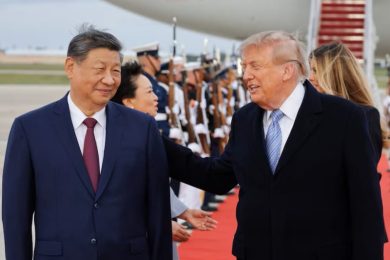
All eyes will be on the next test for global superpower cooperation – the Trump-Xi summit expected in mid-May 2026. It remains to be seen whether Trump approaches China mainly as a trade counterpart for a possible deal, or as the central strategic challenge in the Indo-Pacific. This uncertainty is why the EU’s FTA strategy warrants attention. The EU is unable to replace the US’ role as a counterbalance to China in the Indo-Pacific region, nor can it match China’s scale in regional trade. Its value lies elsewhere: a stable, rules-based economic partnership that gives Indo-Pacific partners more room to manoeuvre. In a region wary of overdependence on any single power, EU FTAs are becoming instruments of strategic diversification as much as trade liberalisation.
Sources:
- https://www.atalayar.com/en/articulo/politics/the-birth-of-the-third-space-europe-canada-and-the-indo-pacific-in-the-face-of-the-era-of-superpowers/20260219090000223479.html
- https://www.foreignminister.gov.au/minister/penny-wong/media-release/australia-european-union-security-and-defence-partnership
- https://table.media/en/europe/feature/indo-pacific-how-the-eu-is-expanding-its-strategic-alliances
- https://www.orfonline.org/research/the-role-of-trade-in-india-s-geoeconomic-strategy
- https://policy.trade.ec.europa.eu/eu-trade-relationships-country-and-region/negotiations-and-agreements_en
- https://www.whitehouse.gov/fact-sheets/2026/03/fact-sheet-president-donald-j-trump-strengthens-u-s-japan-alliance-for-the-benefit-of-all-americans/
- https://www.mofa.go.jp/na/na1/us/pageite_000001_00007.html
- https://www.reuters.com/world/asia-pacific/trump-calls-xi-meeting-important-trip-says-us-leads-ai-2026-05-04/
- https://ip-quarterly.com/en/why-countries-indo-pacific-are-looking-europe